
The double-hoist double-girder overhead crane is an overhead crane equipped with two independent hoisting mechanisms (i.e., double hoists). It consists of a main girder, end carriages, two electric hoists (or winch systems), a cross-travel mechanism for the trolley, a long-travel mechanism for the crane, a small trolley travel mechanism, and a control system. The two electric hoists can be installed on the same main girder (arranged in parallel or staggered) or separately within a double-girder structure, enabling coordinated or independent operation.
The double-hoist overhead crane can be divided into two main types based on the main girder structure: single-girder and double-girder. They have significant differences in structural design, load capacity, and application scenarios.
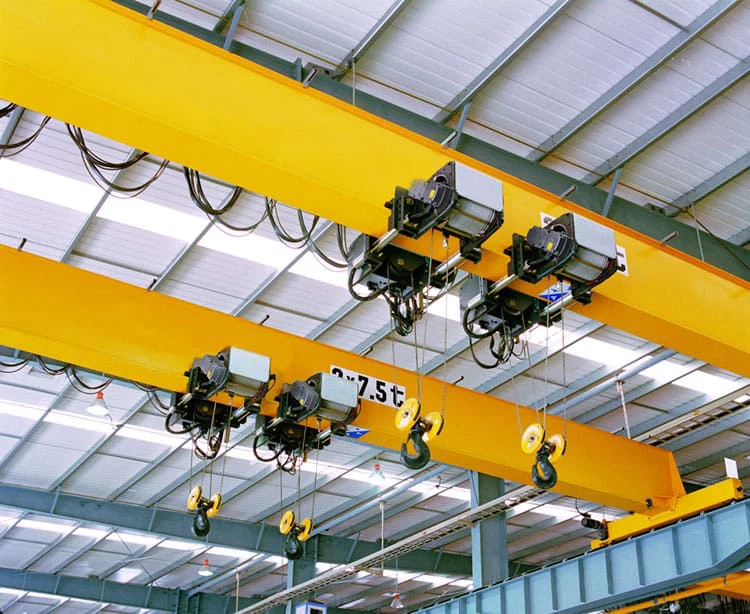
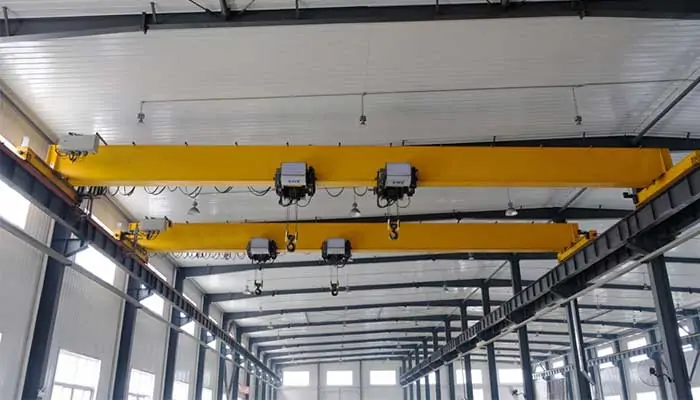
The single-girder double-hoist overhead crane uses one box girder or I-beam as the main load-bearing structure, with two electric hoists (usually wire rope or chain hoists) installed on the same main girder. The load capacity is typically 5~20 tons (single hoist) or 10~32 tons (dual-hoist combined lifting), with a span range of 5~22 meters.

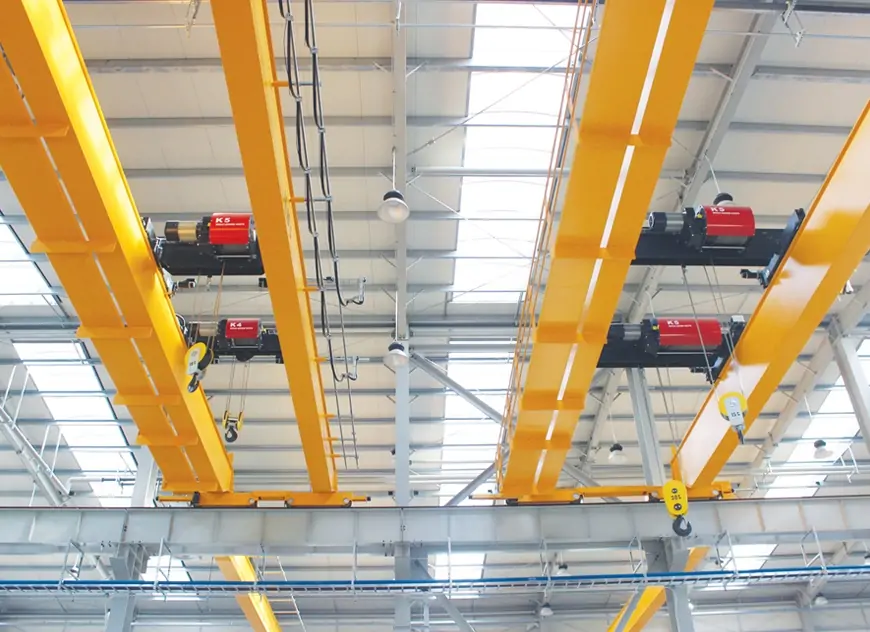
The double-girder double-hoist crane utilizes two box girders or truss girders to provide greater rigidity and load capacity. It is suitable for heavy loads ranging from 20 to 500 tons or even higher (e.g., in metallurgy, shipbuilding industries). The span range is 10~35 meters, suitable for large plants. Common types include the LH double-girder overhead crane and the NLH European-type double-girder overhead crane.
| Model | LH Type | NLH Type (European-style) |
| Applicable Scenarios | Light frequent handling (machining, assembly lines, small warehouses) | Medium and heavy precision operations (steel processing, heavy installation, logistics warehousing) |
| Lifting Capacity | 1-20t | 5-32t |
| Hoisting Mechanism | CD1/MD wire rope electric hoist | New Chinese style electric hoist (dual-speed/frequency conversion) |
| Control Mode | Conventional control | Frequency conversion / Remote control / Automation control |
| Operational Precision | General | High (anti-sway, precise positioning) |
| Structural Features | Low headroom, low cost | High-strength design, long service life |
| Cost | Economical and practical | Ultra-high cost performance |

The electromagnetic overhead crane is a double-girder bridge crane equipped with a detachable electromagnetic lifting magnet, using electromagnetic forc…

The QD double-girder overhead crane with hook is a heavy-duty industrial overhead crane featuring a double main girder structure and equipped with a hook as the lifting attachment,…


