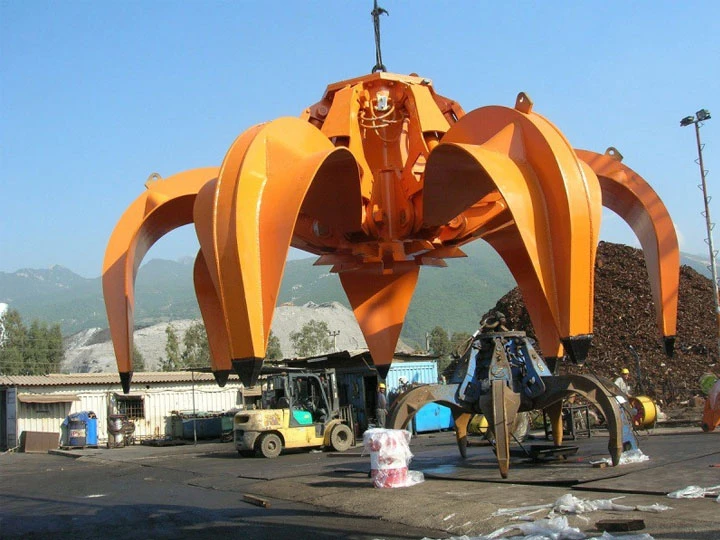
The core function of a grab is to achieve automatic grabbing and unloading of materials through the opening and closing action of its jaws, without the need for auxiliary personnel, thereby improving handling efficiency. Based on drive methods and structural design, grabs can be divided into various types, such as single-rope grabs, double-rope grabs, four-rope grabs, and hydraulic grabs, to meet the requirements of different materials and operating environments. They are widely used in locations such as ports, terminals, railway freight yards, and mines, typically in conjunction with overhead cranes, gantry cranes, or knuckle-boom cranes.
Specifications
Grabs are divided into types such as single-rope grabs, double-rope grabs, four-rope grabs, hydraulic grabs, and electric grabs, and can be customized according to actual requirements.
Grabs are specialized handling tools used by cranes for loading and unloading dry bulk materials. They belong to the bucket-type components in the machinery industry and are typically manufactured using manganese steel. Comprising two or more movable jaws that form a material holding space, they are operated via wire ropes to grasp and discharge materials. Featuring high handling efficiency and low labor intensity, they are the primary equipment for handling major bulk cargoes in ports.
For industries that require extensive handling of bulk materials, a reliable grab means:
Efficiency Improvement: Large single-grab capacity, short cycle times, and more efficient operations.
Cost Control: Reduces reliance on manual labor, lowers overall equipment energy consumption and maintenance costs.
Strong Adaptability: Specialized designs available for different materials (e.g., ore, grain, scrap steel, garbage).
Safety and Reliability: Sturdy structure and advanced control ensure the safety of operators and the worksite.
Common Grab Classifications
Based on drive methods and material characteristics, we offer the following main categories of grabs to help you make a precise choice:
Having trouble selecting the right model? We offer free technical consultation to recommend the optimal solution based on your material, crane parameters, and working conditions.
Structural Composition
Our grabs feature a modular, high-strength design, ensuring every component withstands rigorous demands:
Main Structure:
High-Strength Steel Plate Welding: Key load-bearing parts use high-strength alloy steel, processed with precision welding and stress relief treatment, ensuring a sturdy structure and fatigue resistance.
Optimized Mechanical Design: Jaw curves and hinge point layouts are optimized through computer simulation, resulting in high filling ratios and low resistance during grabbing.
Core Components:
Jaws and Cutting Edges: Can be equipped with wear-resistant steel edges, manganese steel liners, or rubber sealing edges based on material characteristics, significantly extending service life.
Hinge and Bearing System: Utilizes heavy-duty wear-resistant bearings and hardened pins, with comprehensive lubrication design for smooth rotation and minimal wear.
Drive Unit (Hydraulic/Electric): Selects renowned brand hydraulic systems or high-efficiency motors with high IP protection ratings, suitable for harsh operating conditions.
Safety Devices:
Standard features include overload protection, limit switches, anti-leak/anti-loosening devices, etc. Some models offer optional condition monitoring sensors.
Advantages & Features
Superior Grabbing Performance
Jaw designs optimized for different materials ensure high filling rates and grabbing force, eliminating issues like ‘inability to grab’ or ‘rapid leakage’.
Exceptional Durability
From materials to processes, the wear and impact resistance of key components are comprehensively enhanced, significantly reducing downtime and replacement costs.
Efficient Energy Consumption
Optimized hydraulic systems or high-efficiency motors provide powerful force while consuming less energy, lightening the load on your crane.
Minimal Maintenance Requirements
Modular design facilitates quick inspection and repair; centralized lubrication points simplify daily maintenance; universal spare parts ensure supply reliability.
Excellent Safety and Sealing
Reliable structure and good sealing (especially for materials like grain) prevent material spillage, ensuring worksite cleanliness and safety.
Intelligent Customization
Can integrate weighing systems, condition monitoring (oil temperature, pressure, wear), and anti-sway control for data-driven and intelligent management.
Applications
Our grabs serve various fundamental sectors of the national economy:
Ports and Terminals: Loading/unloading bulk carriers (coal, ore, grain, fertilizer).
Steel & Scrap Recycling: Scrap steel handling, stacking/reclaiming, raw material transfer within steel plants.
Power Generation & Energy: Stacking/reclaiming in power plant coal yards, biomass fuel handling.
Construction Materials: Handling and transfer of raw materials like sand, gravel, cement.
Waste Treatment: Grabbing and loading of municipal solid waste, construction waste, and industrial solid waste.
Grain & Agriculture: Grain loading/unloading and silo transfer operations in granaries and grain depots.
Logistics & Warehousing: Yard management for bulk commodities.
A leading enterprise in China's crane industry, with an annual production capacity exceeding 100,000 sets of lifting equipment. Its smart factory ranks among the industry's top in scale and production capacity. In 2023, order volume surpassed 4 billion yuan, with its market coverage and delivery capabilities widely recognized.
Rich experience
With over six decades of deep expertise in the lifting equipment sector, our service network spans more than 170 countries worldwide. Having completed over 500,000 projects across diverse complex industrial scenarios, we have accumulated extensive application experience and solutions.
Qualifications and Honors
The company operates a National-level Enterprise Technology Center and holds over 1,800 authorized patents. It has received 135 provincial-level and higher science and technology awards, led or participated in the formulation of multiple international/national standards, and earned certifications including the National Manufacturing Single Champion title.
Quality Assurance
Strictly implementing the ISO international quality system, with automation rates exceeding 95% in critical processes. Pioneering the “New Chinese-style” structural optimization technology, significantly reducing equipment weight and energy consumption. Rigorous quality control throughout the entire production process ensures safety and reliability.
Technological Innovation
Annual R&D investment accounts for 4%-6% of revenue, with an academician-led technical team of over 1,200 members. Breakthroughs in key bottlenecks such as millimeter-level anti-sway technology (≤2mm) continuously drive the iteration of intelligent, lightweight, and low-carbon technologies.
After-sales Service
With over 300 service centers worldwide, we guarantee 24-hour rapid response. Equipped with the “Crane Butler” intelligent operation and maintenance system, we provide remote diagnostics and preventive maintenance, ensuring full lifecycle service support for your operations.
Grabs are specialized handling tools used by cranes for loading and unloading dry bulk materials. They belong to the bucket-type components in the machinery industry and are typica…
Crane sheaves are critical load-bearing guide components in the hoisting mechanism of a crane. They are typically cast or forged from high-strength alloy steel (such as 34CrMo4) an…